Before the four macromolecules — the stuff underneath
This lesson assumes you already know some chemistry basics. A lot of schools rush past these or skip them entirely, so if any of this is fuzzy, that's about what you were taught, not about you. It takes about ten minutes to fill in, and everything else gets much easier afterwards.
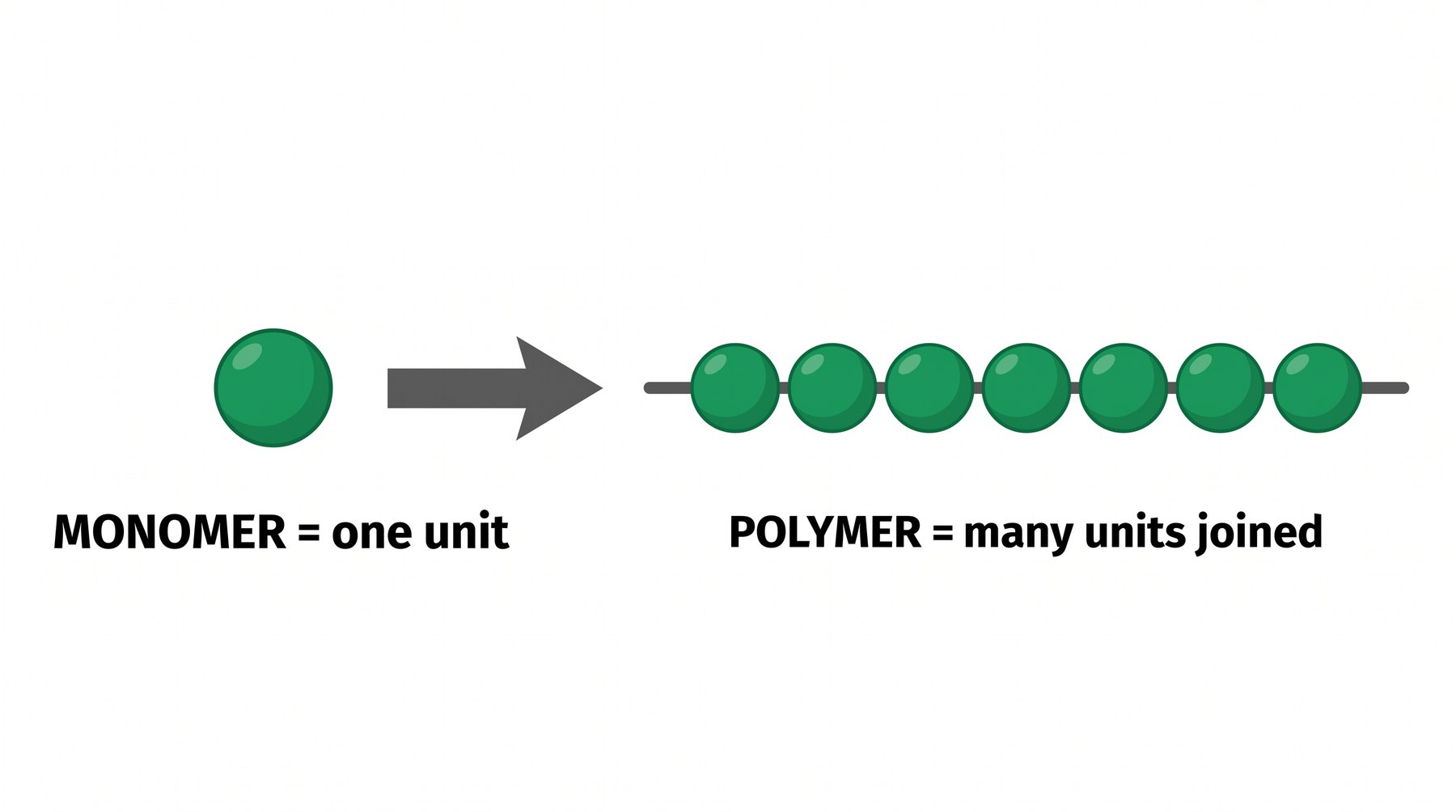
1. Atoms are the letters
An atom is the smallest piece of a pure substance. Different types of atom are called elements — carbon, hydrogen, oxygen, nitrogen, phosphorus. Their symbols are just abbreviations: C, H, O, N, P.
That's the whole idea. Atoms are like letters of an alphabet.
2. Molecules are the words
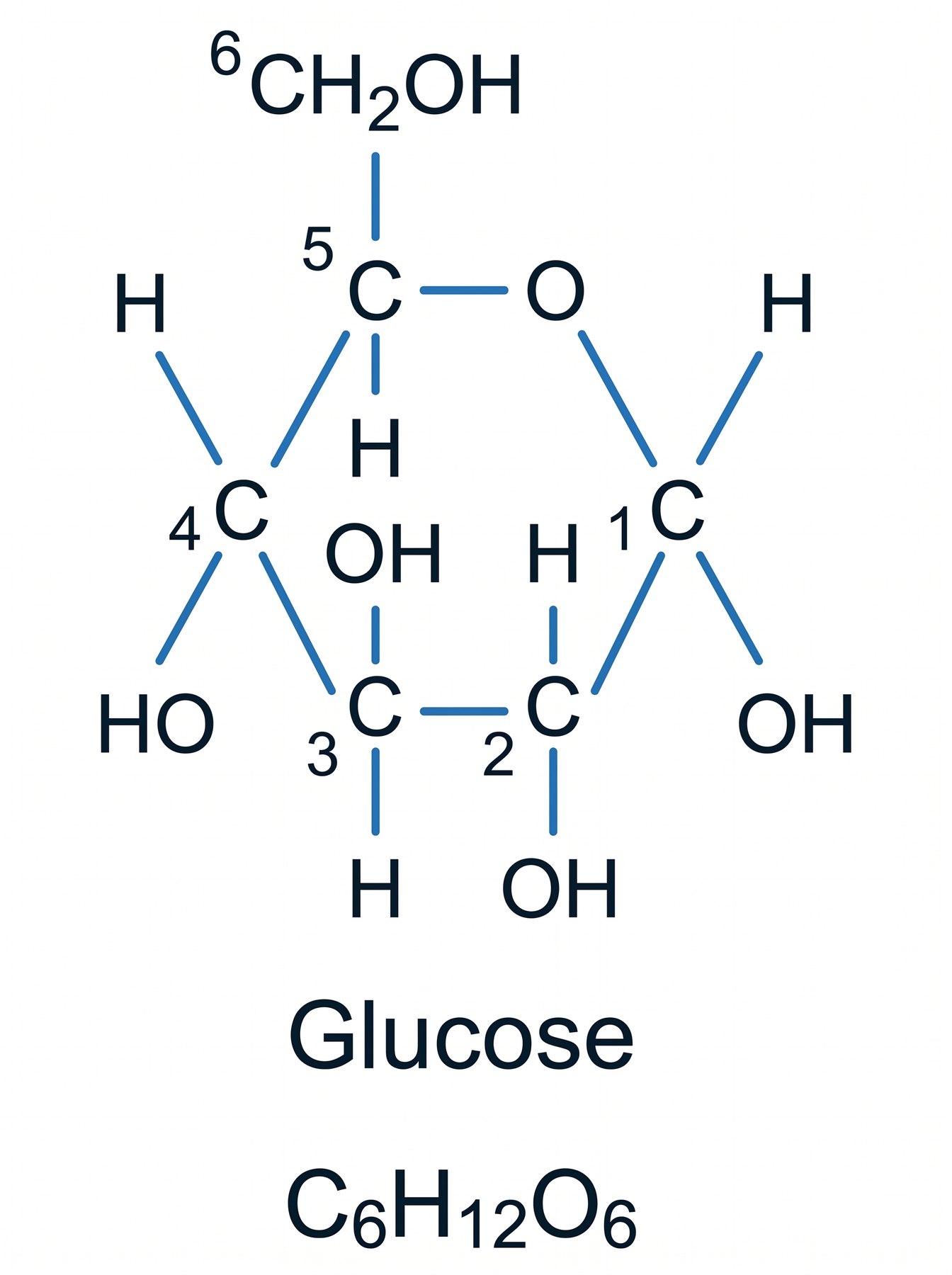
When atoms join together, you get a molecule. Water is a molecule — two hydrogens and one oxygen, H₂O. Glucose is a molecule too, just bigger: C₆H₁₂O₆ means 6 carbons, 12 hydrogens, 6 oxygens.
When you see a formula like that, you're reading a recipe: which atoms, and how many of each.
3. Monomer and polymer — this is the big one
A monomer is one small unit. A polymer is lots of those units joined into a chain.
Think of a bead necklace: one bead is a monomer, the whole necklace is a polymer. Or LEGO: one brick, versus the thing you build from many bricks.
The prefixes literally tell you: mono = one, poly = many. Same as monorail (one rail) or polygon (many sides).
4. Why 'macromolecule' just means 'big molecule'
Macro = big. A macromolecule is a big molecule your body needs. There are four kinds, and this whole lesson is about telling them apart.
Three of them are polymers — built from repeating monomers. One of them isn't. That's the trick the quiz likes.
5. Structure determines function
This sentence shows up all over biology, and it just means: the shape of a thing decides what it can do.
A key's shape decides which lock it opens. A spoon's shape decides that it scoops. Same in your cells — a molecule's shape decides its job. That's why the quiz keeps showing you shapes and asking what they are.
Watch someone else explain it
Chemistry of Life Part 1: The Atom — Start here if atoms and elements feel shaky. Short and slow-paced.
Biomolecules (Amoeba Sisters) — The single best overview of all four macromolecules. Watch this one even if you skip the rest.
Quick check — answer out loud before you peek
In your own words: what's the difference between a monomer and a polymer?
A monomer is one single unit. A polymer is many of those units joined into a chain. One bead vs the whole necklace.
Got it now? Scroll back up and re-read the section — it should land differently.
The master table
Learn these four rows cold. This alone covers most of the quiz.
| Macromolecule | Monomer | Atoms | What it does |
|---|---|---|---|
| Carbohydrate Hexagon rings | Monosaccharide | C, H, O | Main energy source; also structure |
| Lipid (fat) Glycerol + fatty acid tails | none — not a polymer! | C, H, O | Stores energy, insulation, cushioning |
| Protein Folded chains | Amino acid | C, H, O, N | Transport, structure, defence, enzymes |
| Nucleic acid Double helix / single strand | Nucleotide | C, H, O, N, P | Carries genetic information |
Contains phosphorus (P) → nucleic acid — it's the only one with P.
Carbohydrates — think hexagons
Lesson Page 3
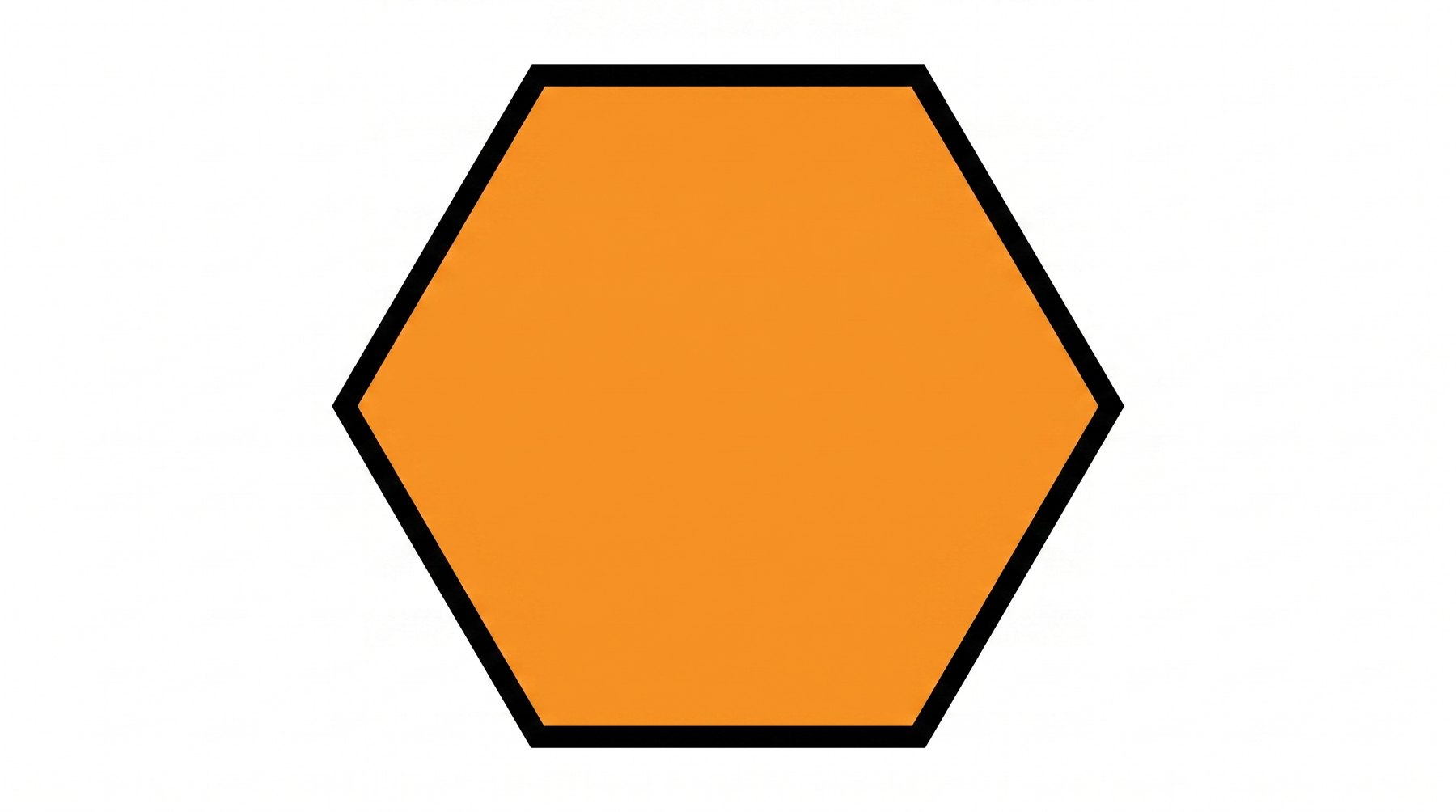
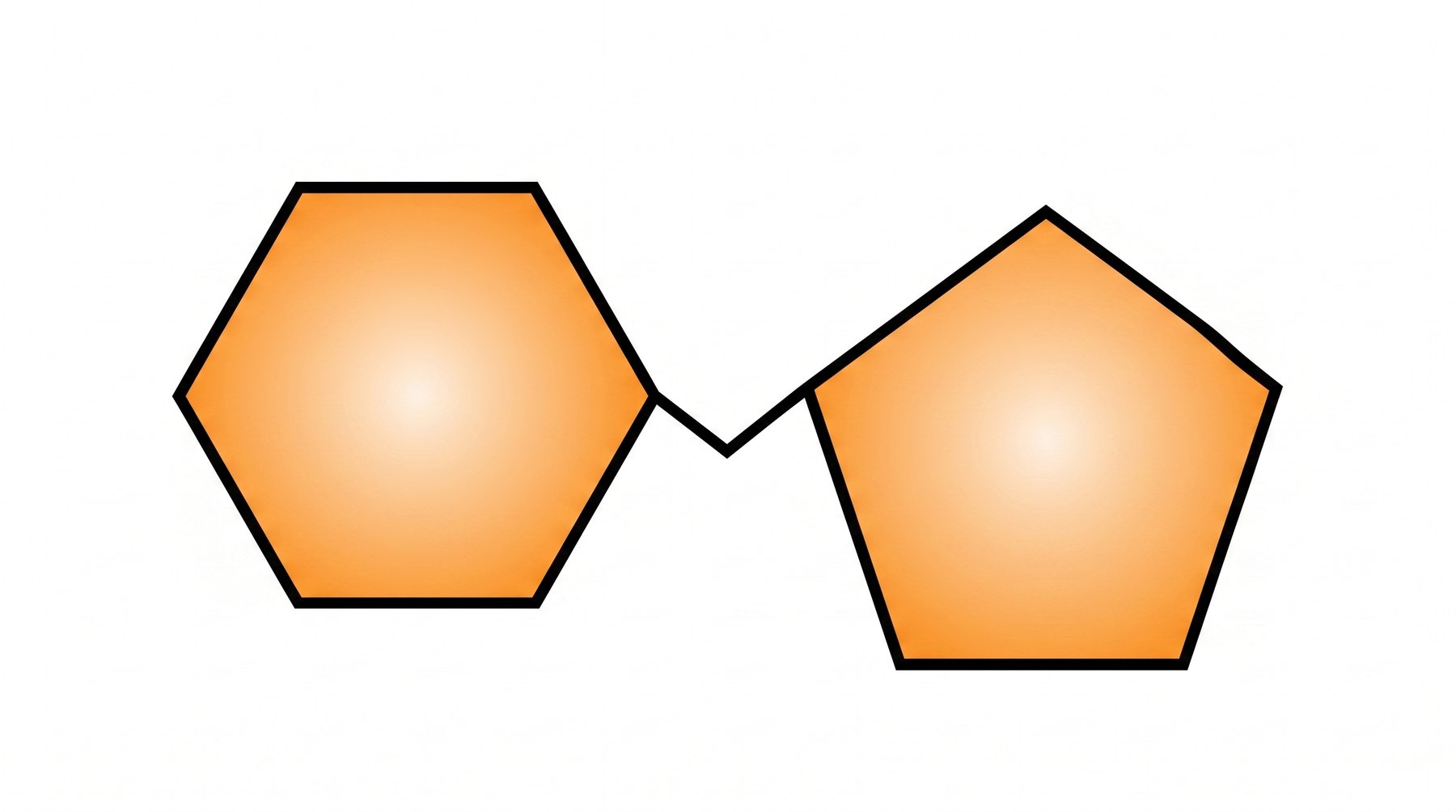
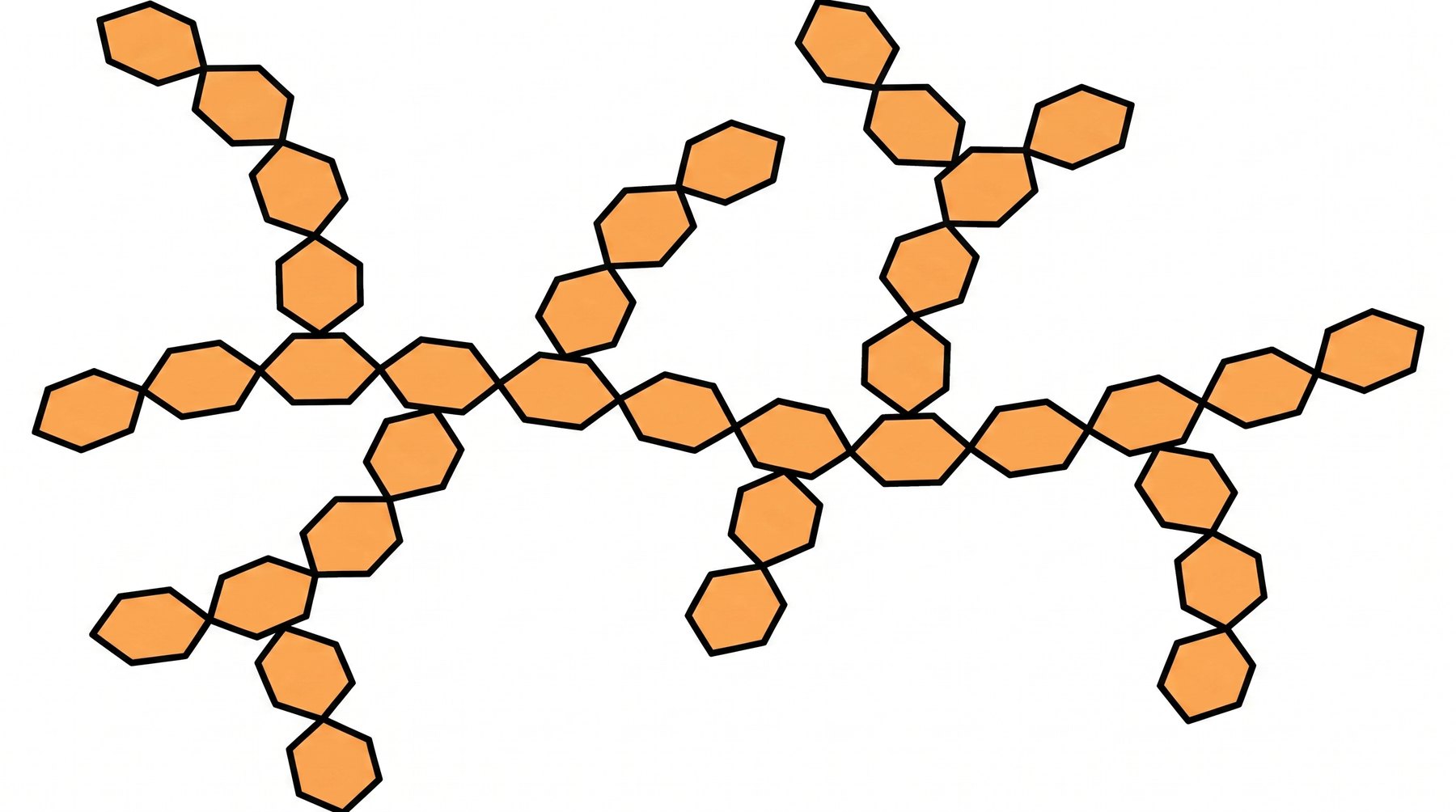
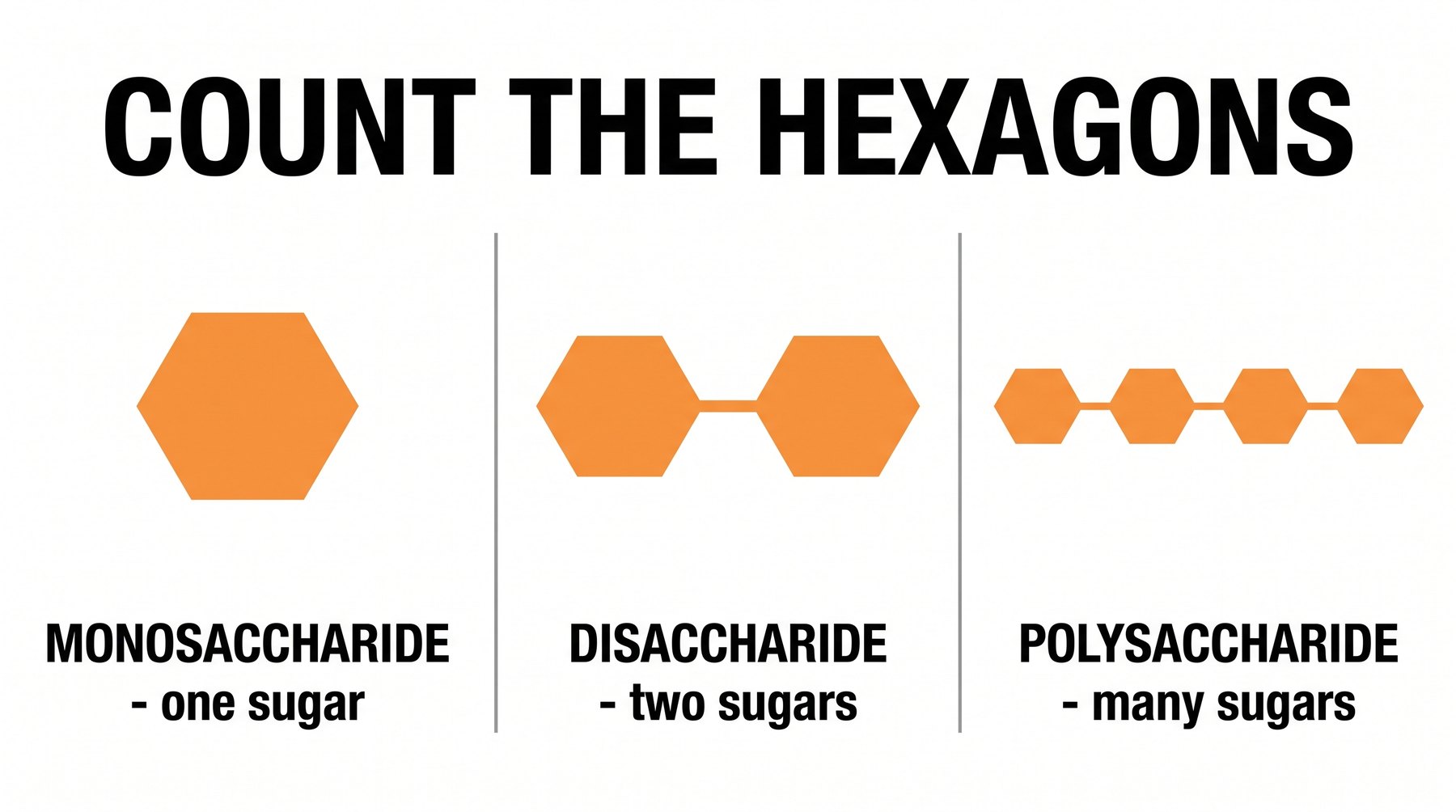
Carbohydrates are made of carbon, hydrogen and oxygen. Living things use them as their main source of energy, and some are structural. Count the hexagons to tell the three types apart.
Carbohydrates are the easiest of the four once you see the pattern, so this is a good place to build some momentum.
Just count the rings
Every carbohydrate picture is hexagons. One hexagon = monosaccharide. Two = disaccharide. Lots = polysaccharide. That's genuinely it.
Tie it to food you know
Glucose (one ring) is blood sugar. Sucrose (two rings) is table sugar. Starch (many rings) is bread, pasta, potatoes. Your body breaks the long ones back down into the short ones for energy.
The name tells you
Saccharide just means sugar. So monosaccharide = one sugar, disaccharide = two sugars, polysaccharide = many sugars.
Watch someone else explain it
Carbohydrates in 60 seconds (Amoeba Sisters) — Quick refresher once you've read the above.
Quick check — answer out loud before you peek
You see a picture of four hexagons joined in a chain. What is it?
A polysaccharide — many sugar units. (And it's a carbohydrate.)
Got it now? Scroll back up and re-read the section — it should land differently.
Lipids — the odd one out
Lesson Page 4
Lipids are macromolecules but not polymers — they aren't built from repeating monomers. The main types are fats, phospholipids and steroids. They're grouped together because they don't dissolve in water (hydrophobic).
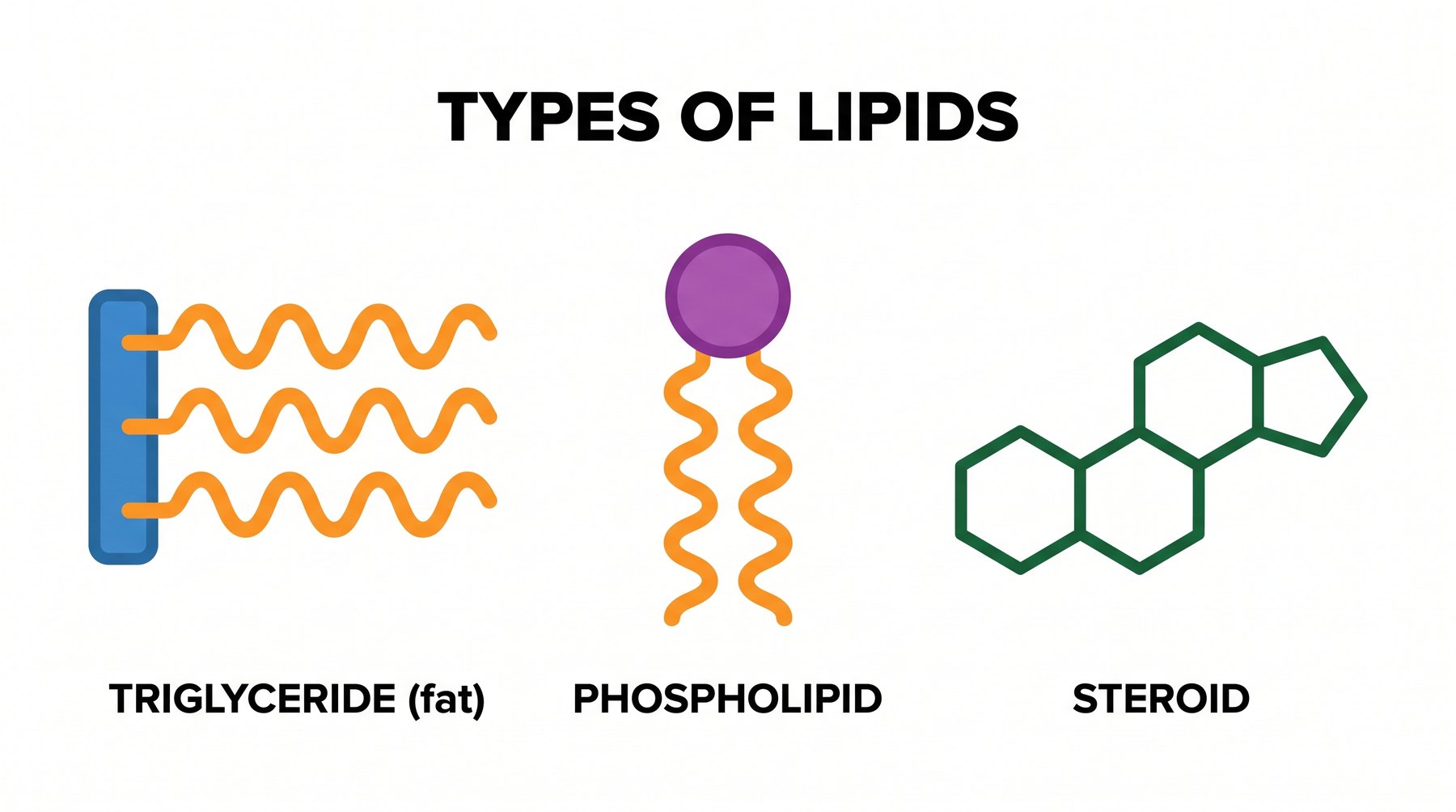
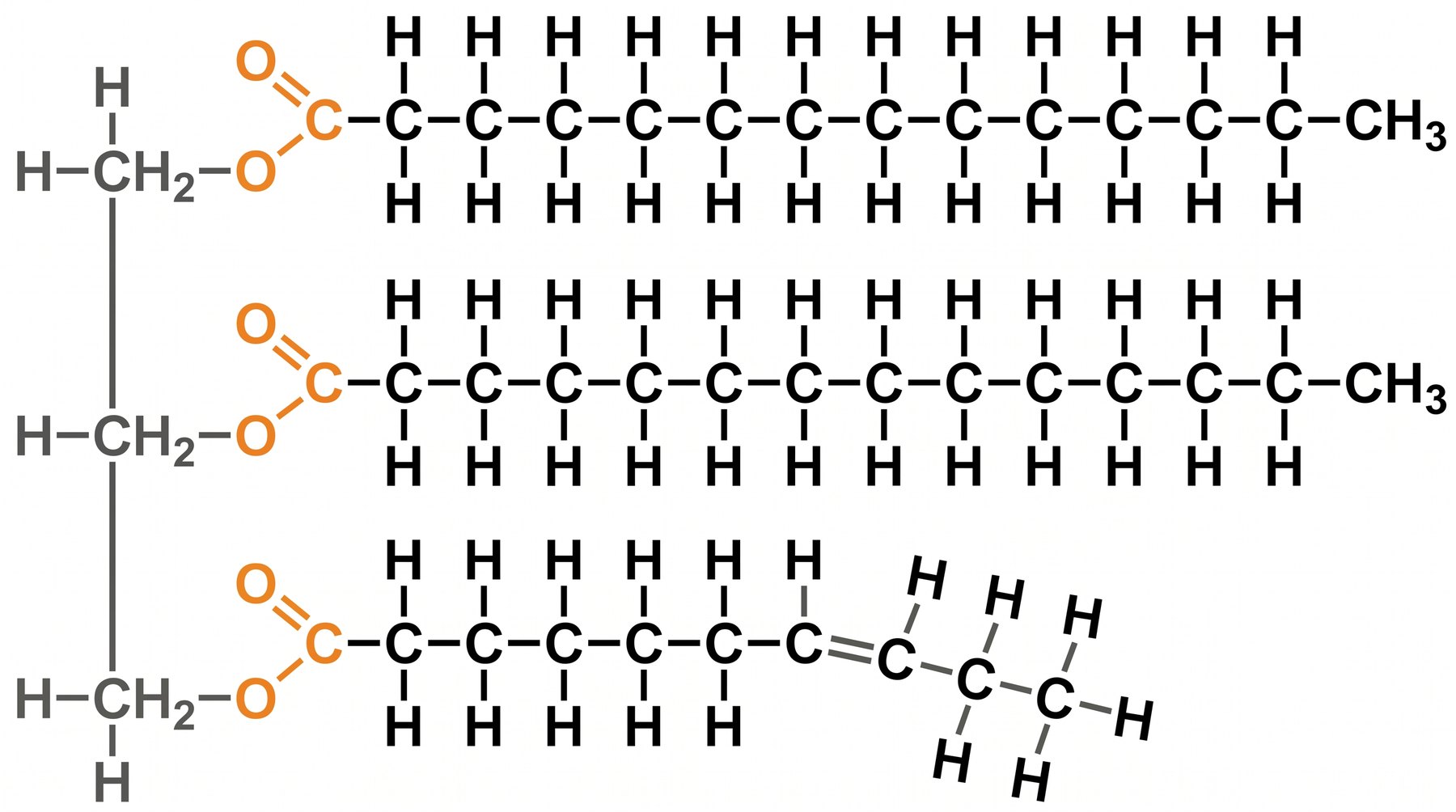
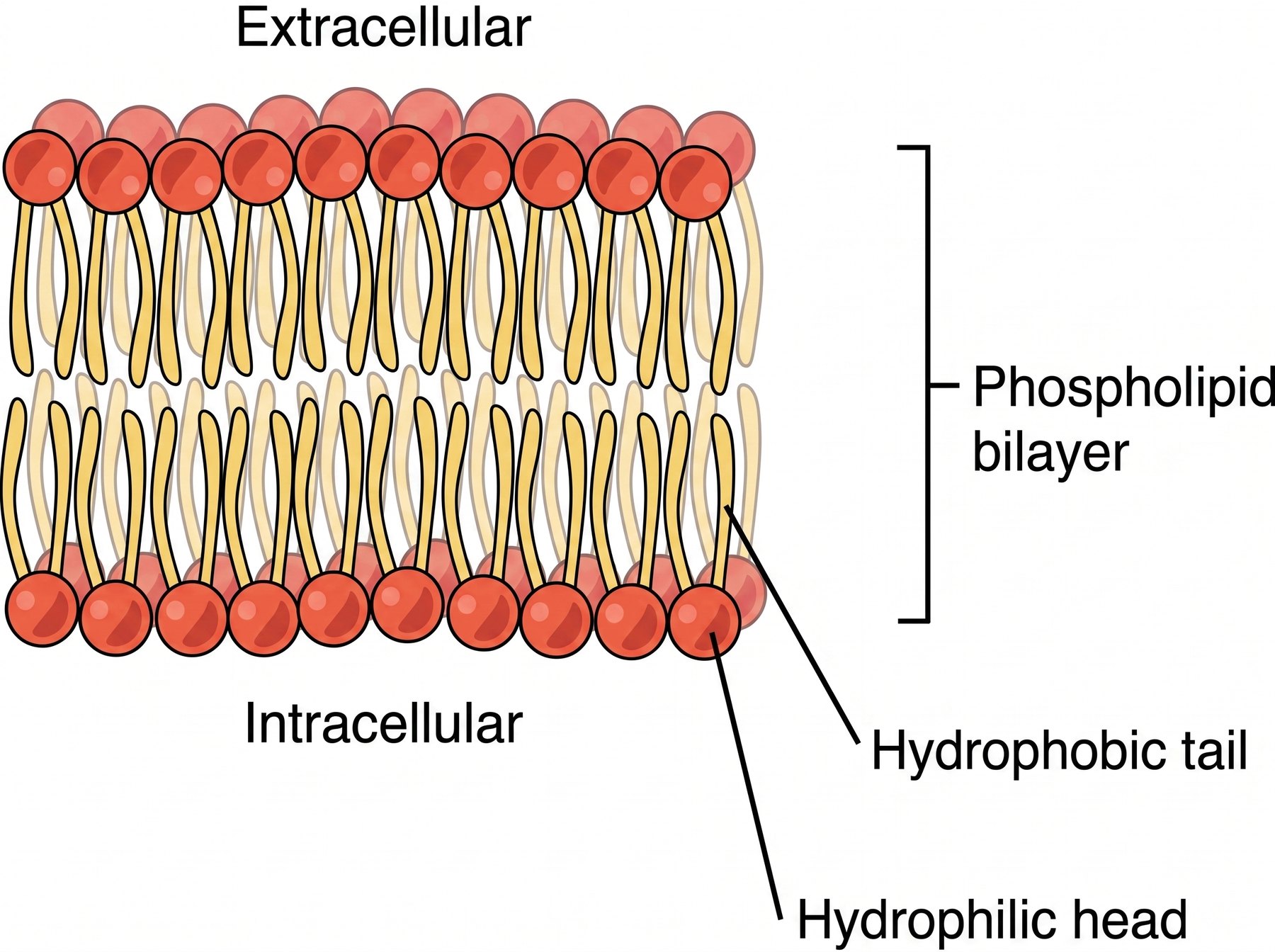
Lipids confuse people because they break the pattern the other three follow. Once you know <i>why</i> they're different, the quiz question about it becomes free points.
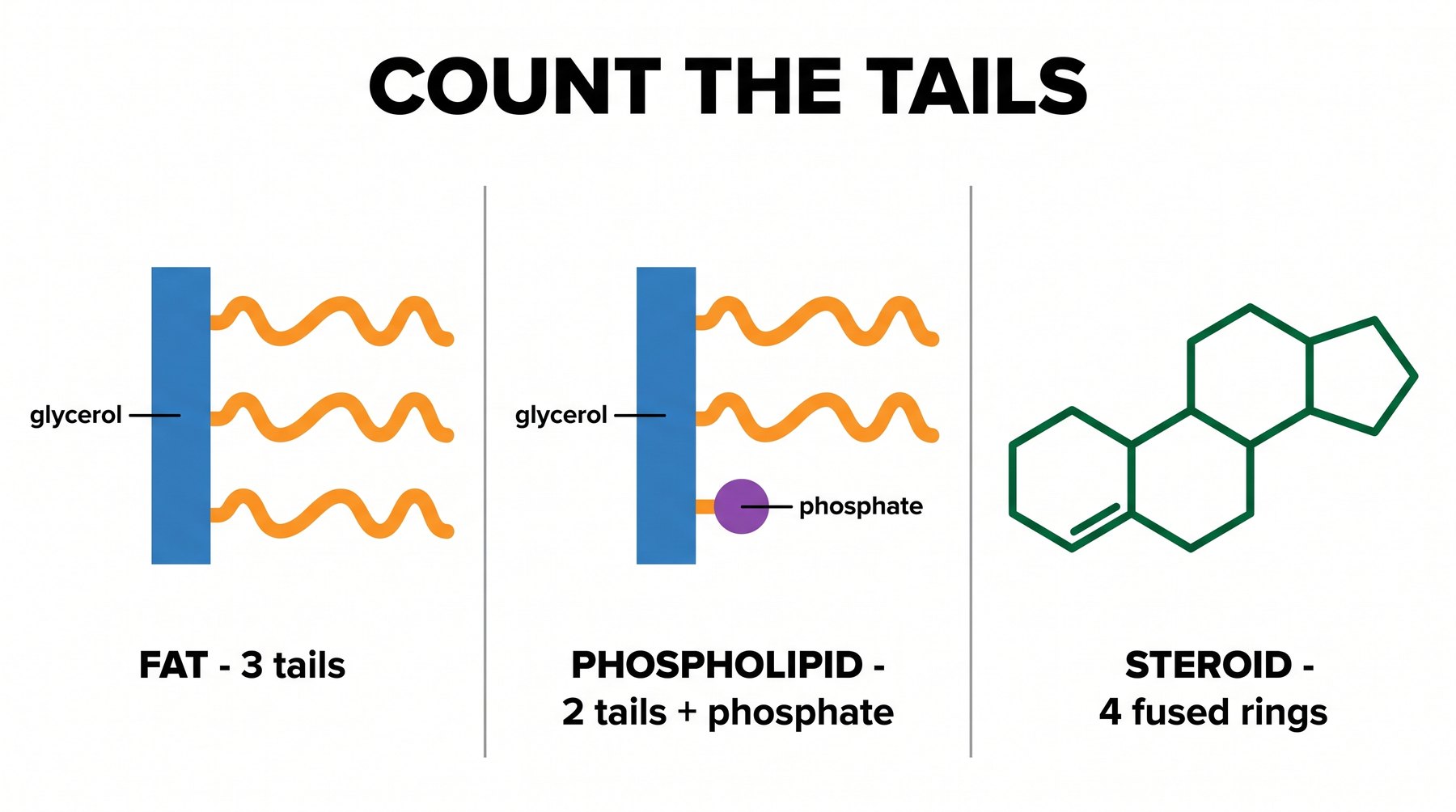
Why they're not polymers
The other three are chains of identical repeating units. A lipid isn't — a fat is a glycerol with fatty acid tails hanging off it. Different parts, not repeating units. So there's no 'monomer of a lipid'.
If a quiz answer says lipids are made of monomers, it's wrong.
Count the tails
3 tails on a glycerol = a fat (also called a triglyceride — tri = three).
2 tails + a phosphate = a phospholipid (phospho is right there in the name).
4 rings, no tails = a steroid.
Why phospholipids build membranes
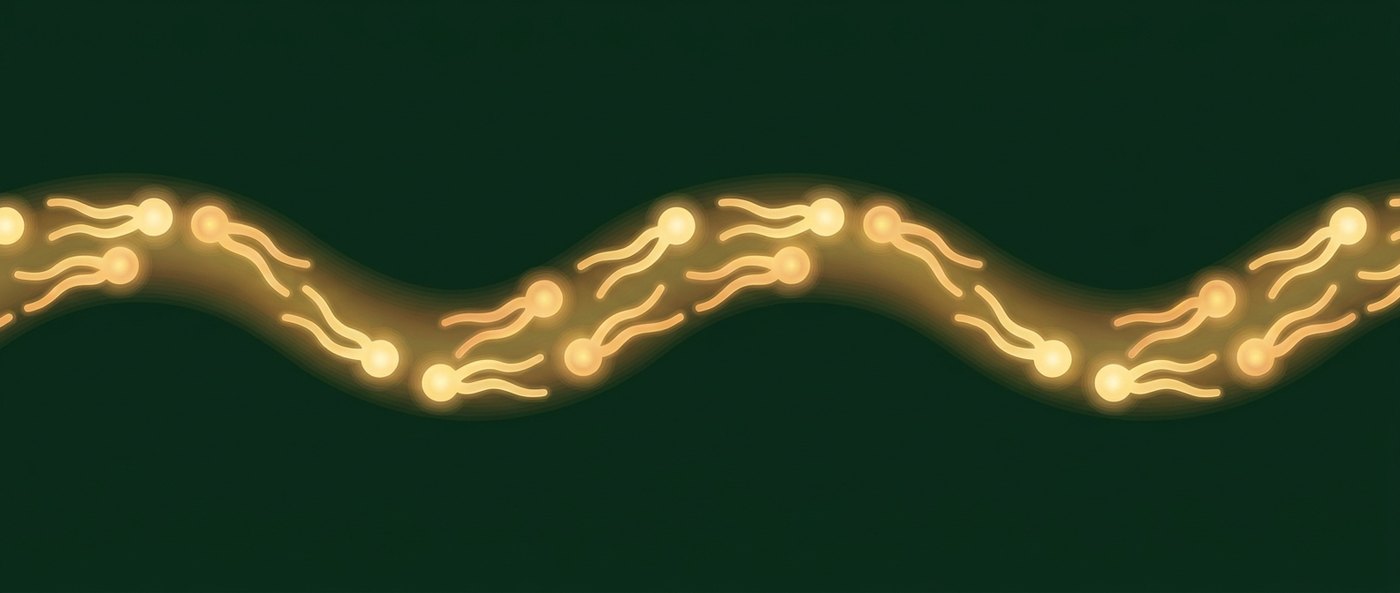
One end of a phospholipid likes water, the other end hates it. So in water they line up in two layers with the water-hating tails tucked inside. That's a cell membrane — it forms itself because of the shape. (Structure determines function again.)
Quick check — answer out loud before you peek
Why don't lipids have a monomer?
Because they aren't built from repeating identical units — a fat is a glycerol plus different fatty acid tails, not a chain of one thing.
Got it now? Scroll back up and re-read the section — it should land differently.
Proteins — amino acids
Lesson Page 5
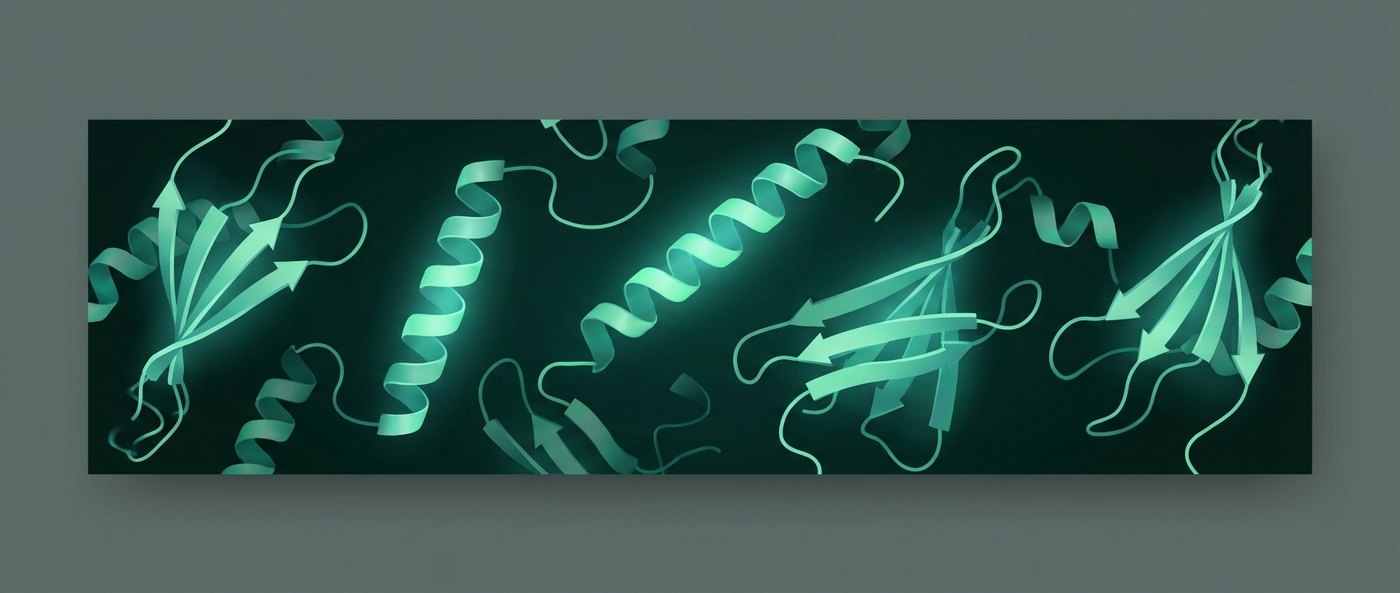
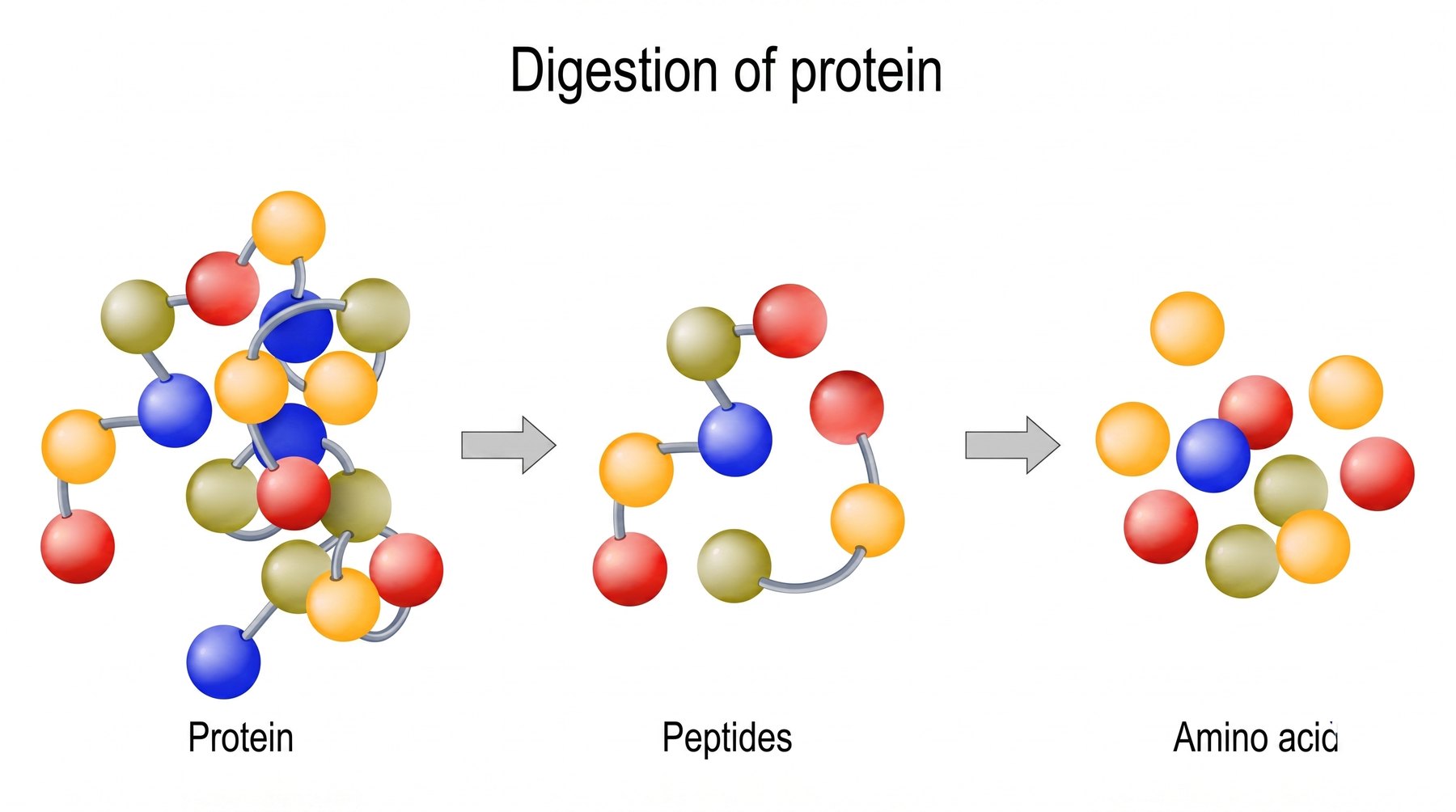
Proteins are polymers of amino acids. They contain nitrogen as well as carbon, hydrogen and oxygen. They do more different jobs than any other macromolecule — transport, structure, defence, and all enzymes are proteins.
Proteins do more different jobs than any other macromolecule, which is exactly why they matter later in the course.
The monomer is an amino acid
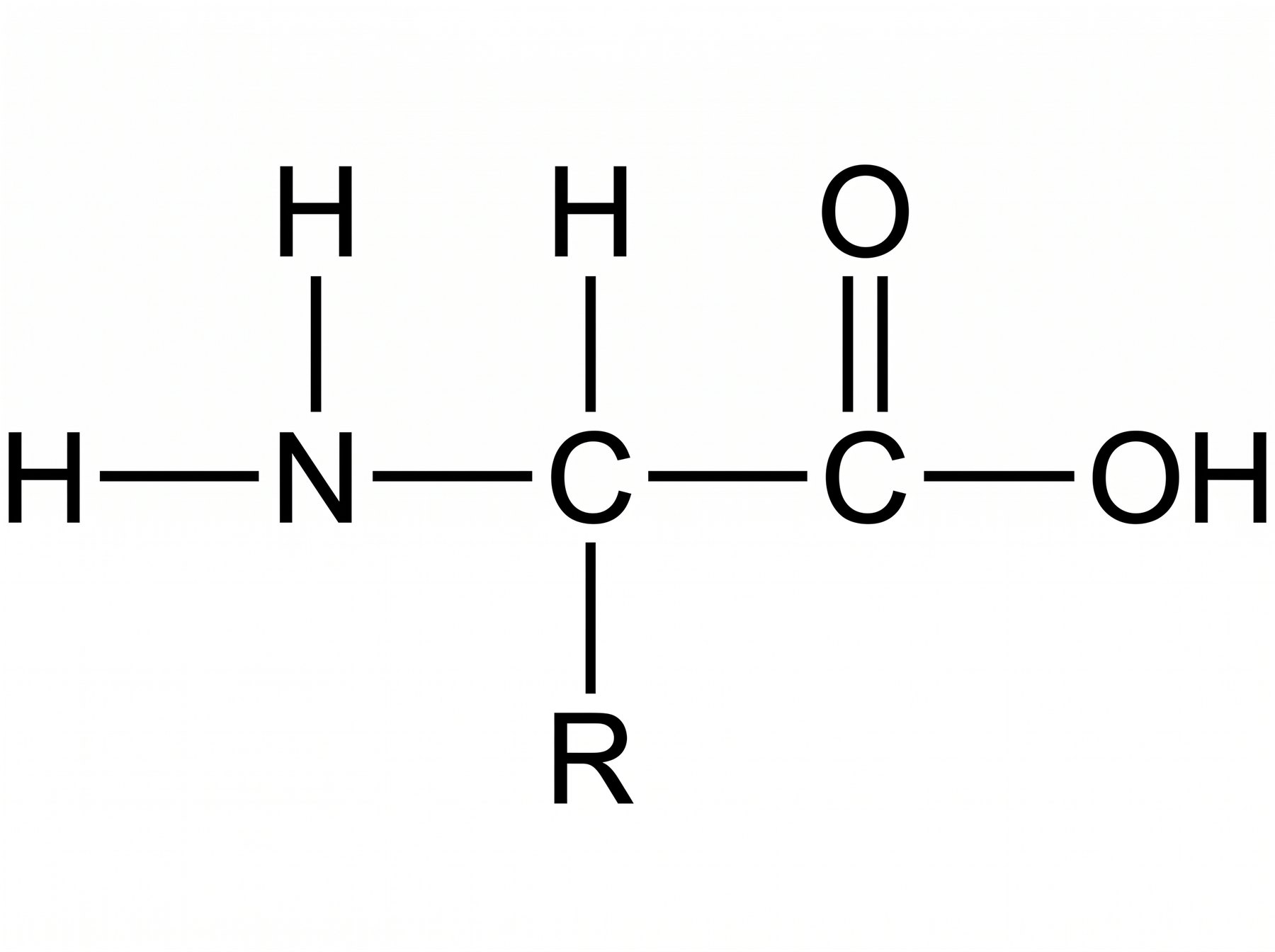
An amino acid has a central carbon with four things attached — an amino group, a carboxyl group, a hydrogen, and an 'R group'. The R group is the part that's different in each amino acid. You don't need to memorise the parts for this quiz; you need to recognise the shape and know the word.
Chain, then fold
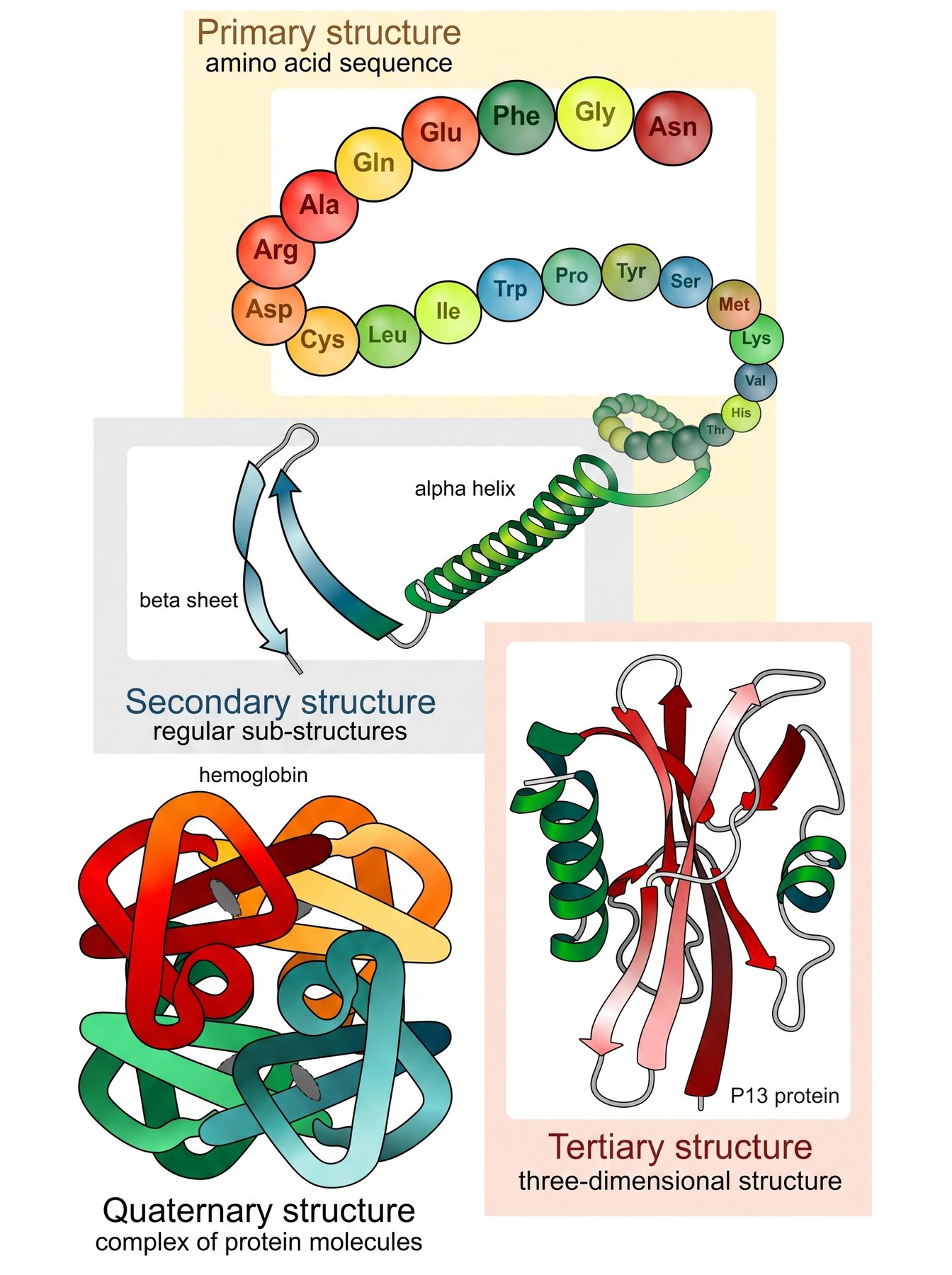
Amino acids link into a chain, and then the chain folds into a specific 3-D shape. The fold is what gives the protein its job — and it's why heating a protein (denaturing it) breaks it.
The nitrogen clue
Carbs and lipids are just C, H, O. Proteins add nitrogen. So if a question mentions nitrogen, you're in protein territory.
Watch someone else explain it
Roles of Proteins (Amoeba Sisters) — 60 seconds on the many jobs proteins do.
Quick check — answer out loud before you peek
Which two elements separate proteins from carbohydrates?
Proteins contain nitrogen (carbs don't). Both have C, H and O.
Got it now? Scroll back up and re-read the section — it should land differently.
Nucleic acids — nucleotides
Lesson Page 7
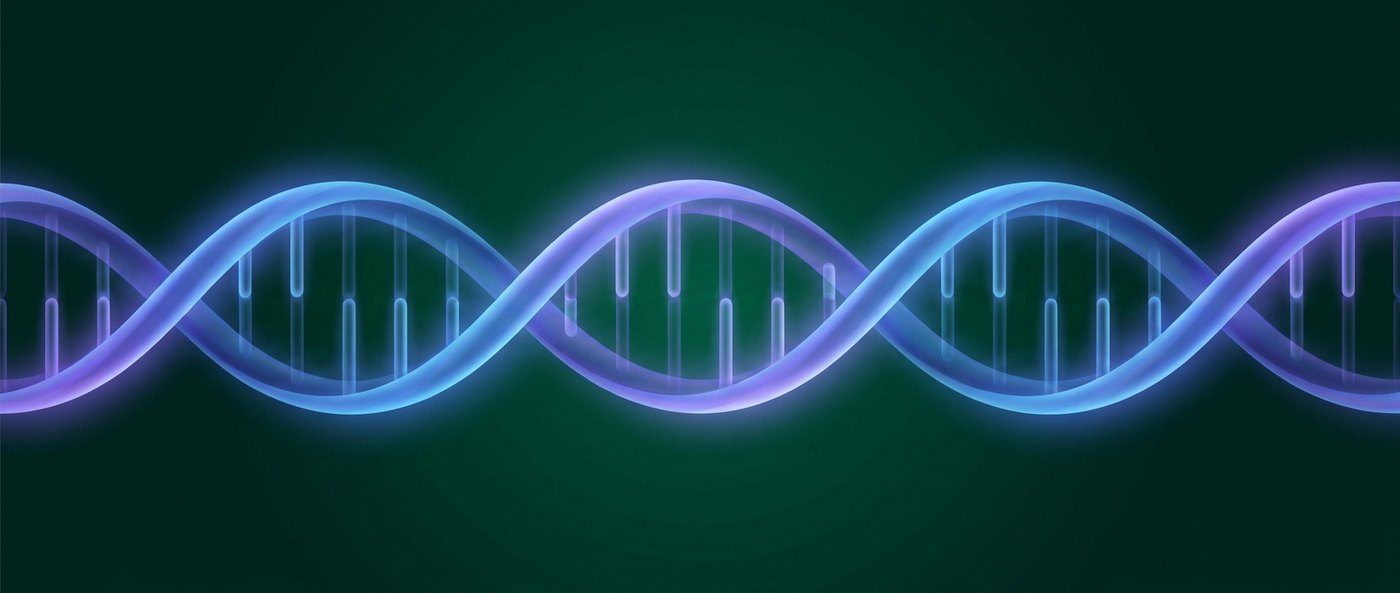
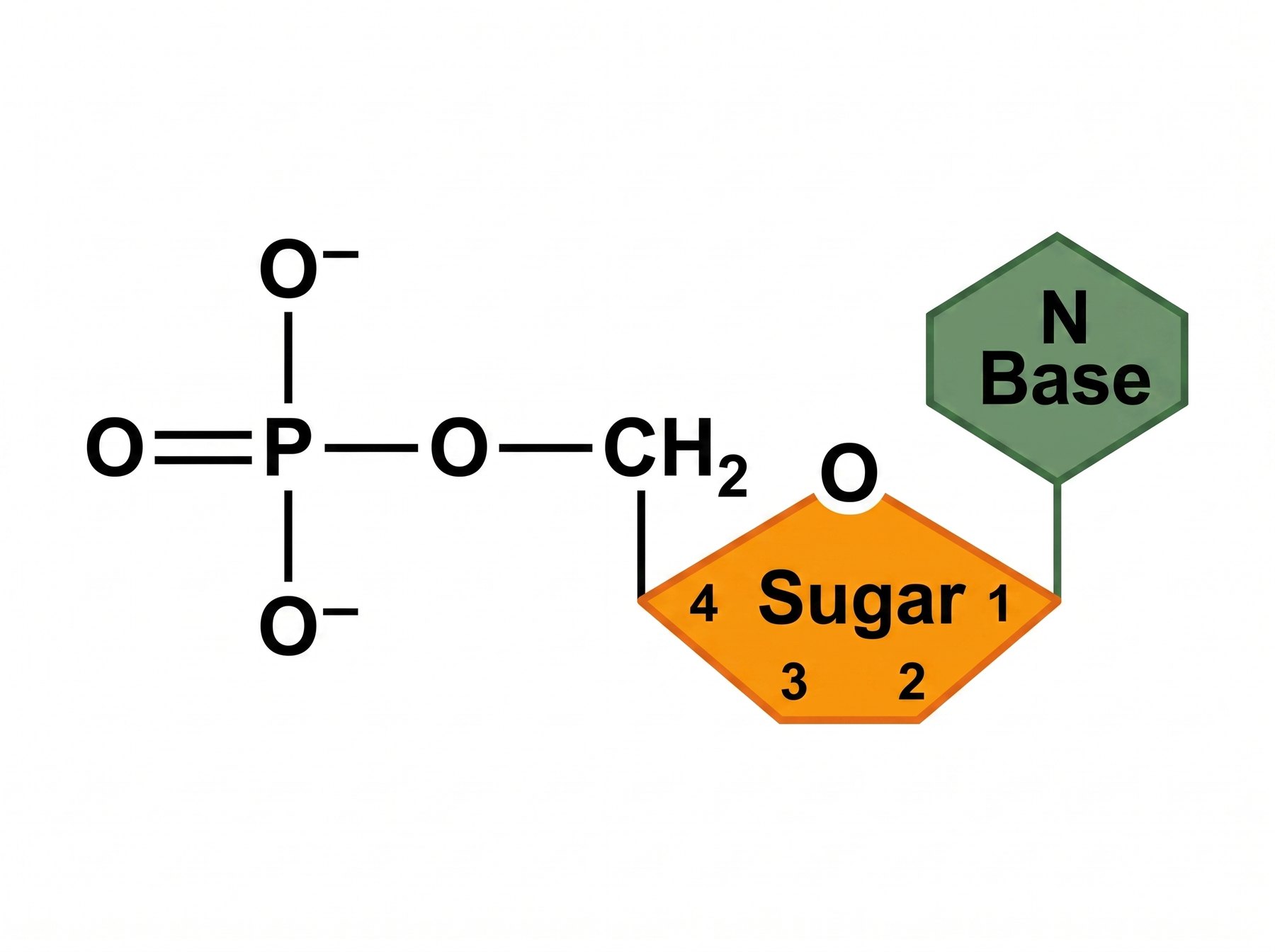
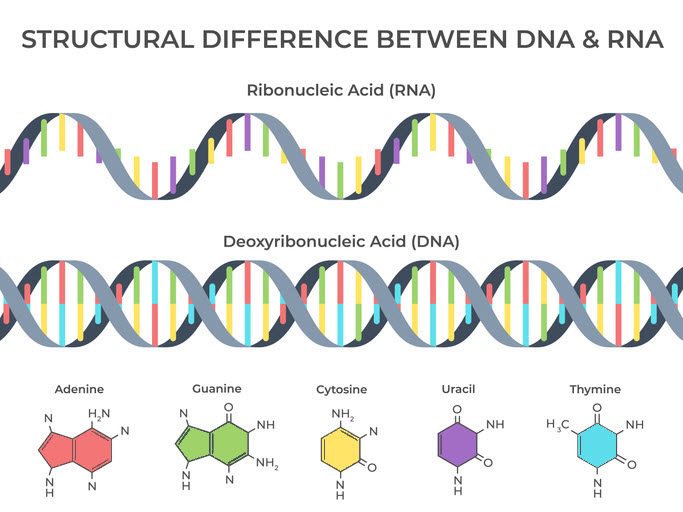
Nucleic acids are polymers of nucleotides. Each nucleotide is a nitrogenous base + a 5-carbon sugar + a phosphate group. DNA is the master copy of genetic information; RNA copies sections of it and carries them out of the nucleus.
You already know what DNA does from general knowledge — this section is mostly about naming the parts.
One nucleotide = three pieces
A nitrogenous base + a 5-carbon sugar + a phosphate group. Three parts, always. String nucleotides together and you get a nucleic acid.
DNA vs RNA in one line
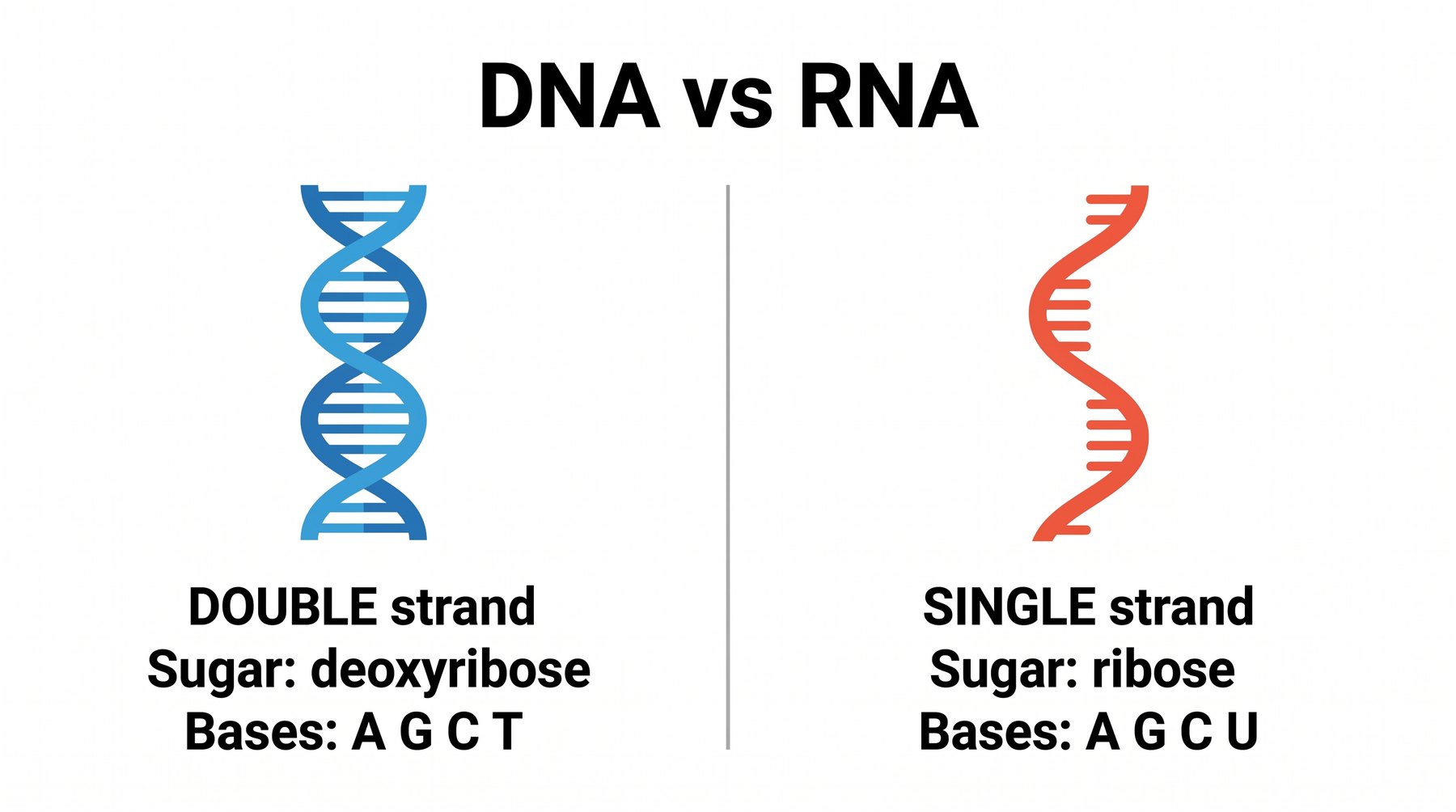
DNA: Double strand. Sugar is deoxyribose. Bases A G C T.
RNA: single strand. Sugar is ribose. Bases A G C U.
Memory hook: D for Double and Deoxyribose. U only shows up in RNA.
The phosphorus giveaway
Nucleic acids are the only macromolecule containing phosphorus. If a question lists P among the atoms, the answer is nucleic acid.
Quick check — answer out loud before you peek
A molecule is single-stranded and contains uracil. What is it?
RNA — single strand and U both point to RNA.
Got it now? Scroll back up and re-read the section — it should land differently.
Enzymes — the hardest part
Lesson Page 6
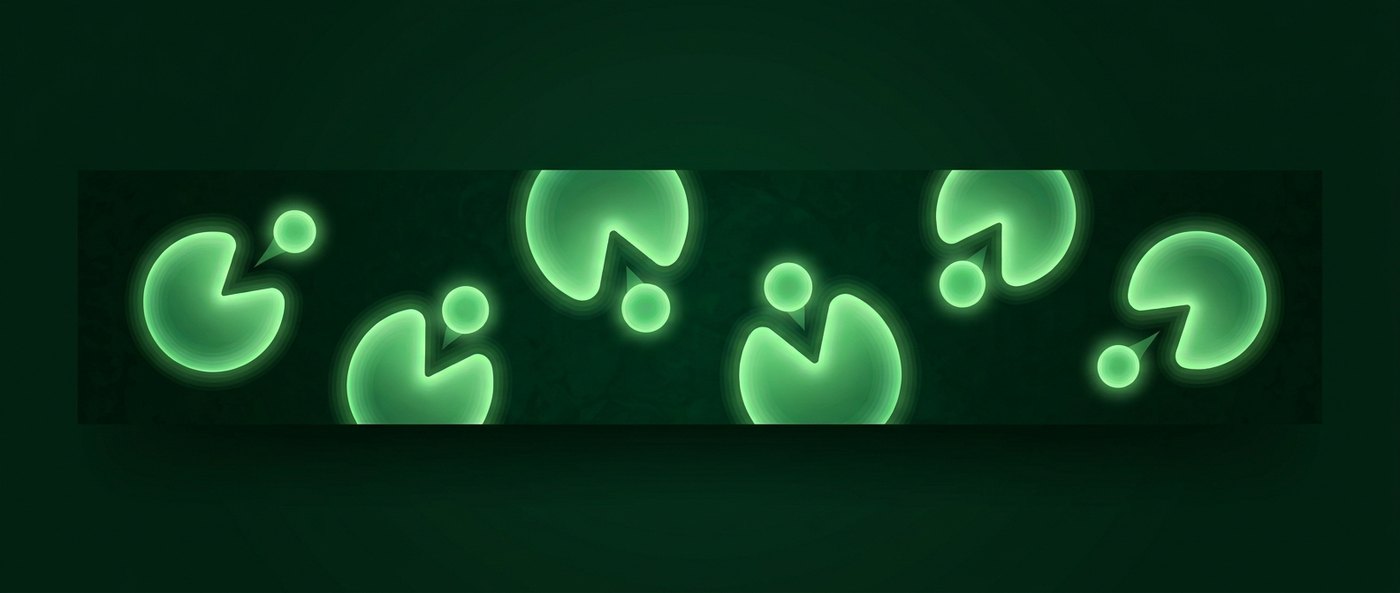
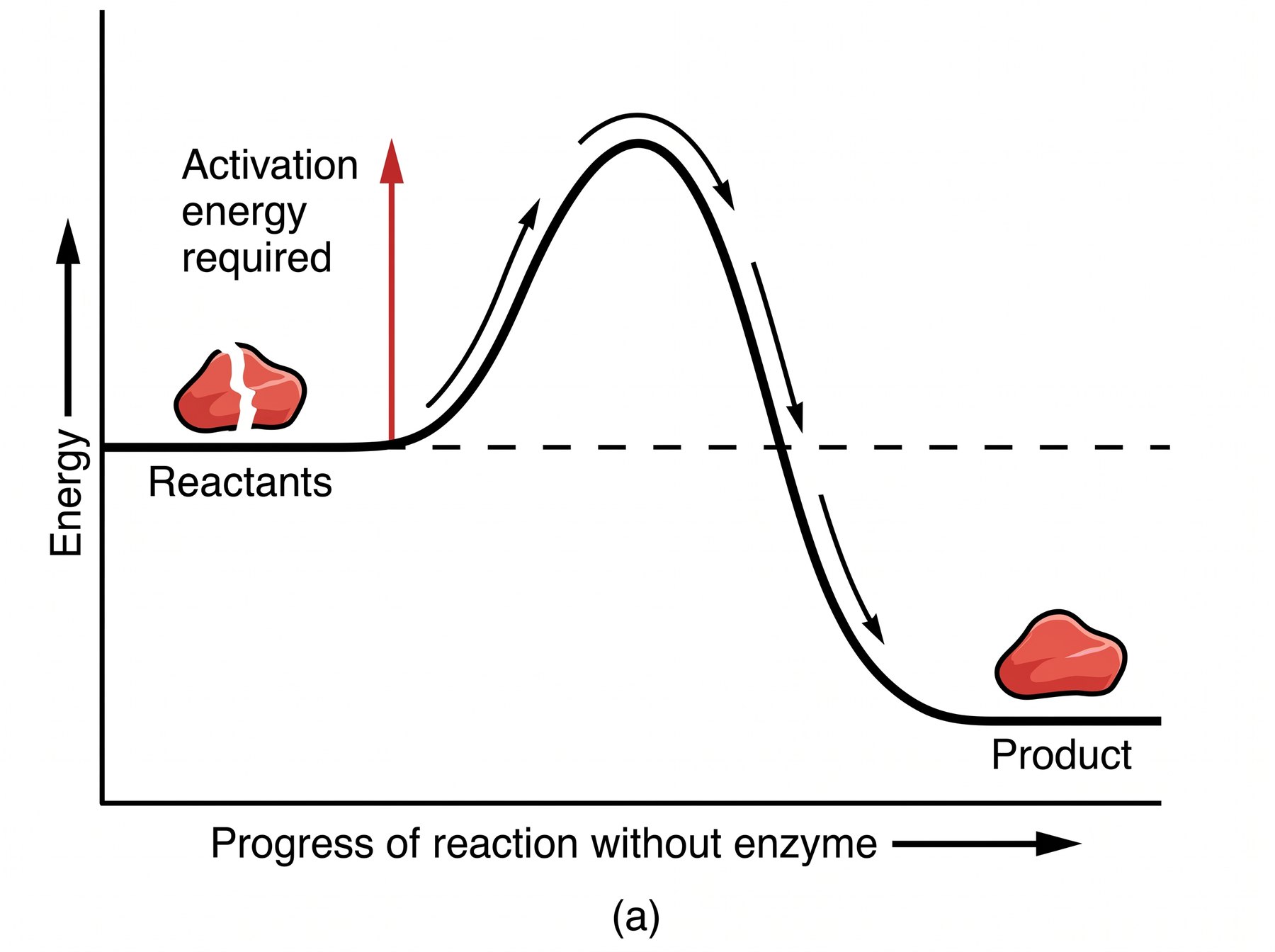
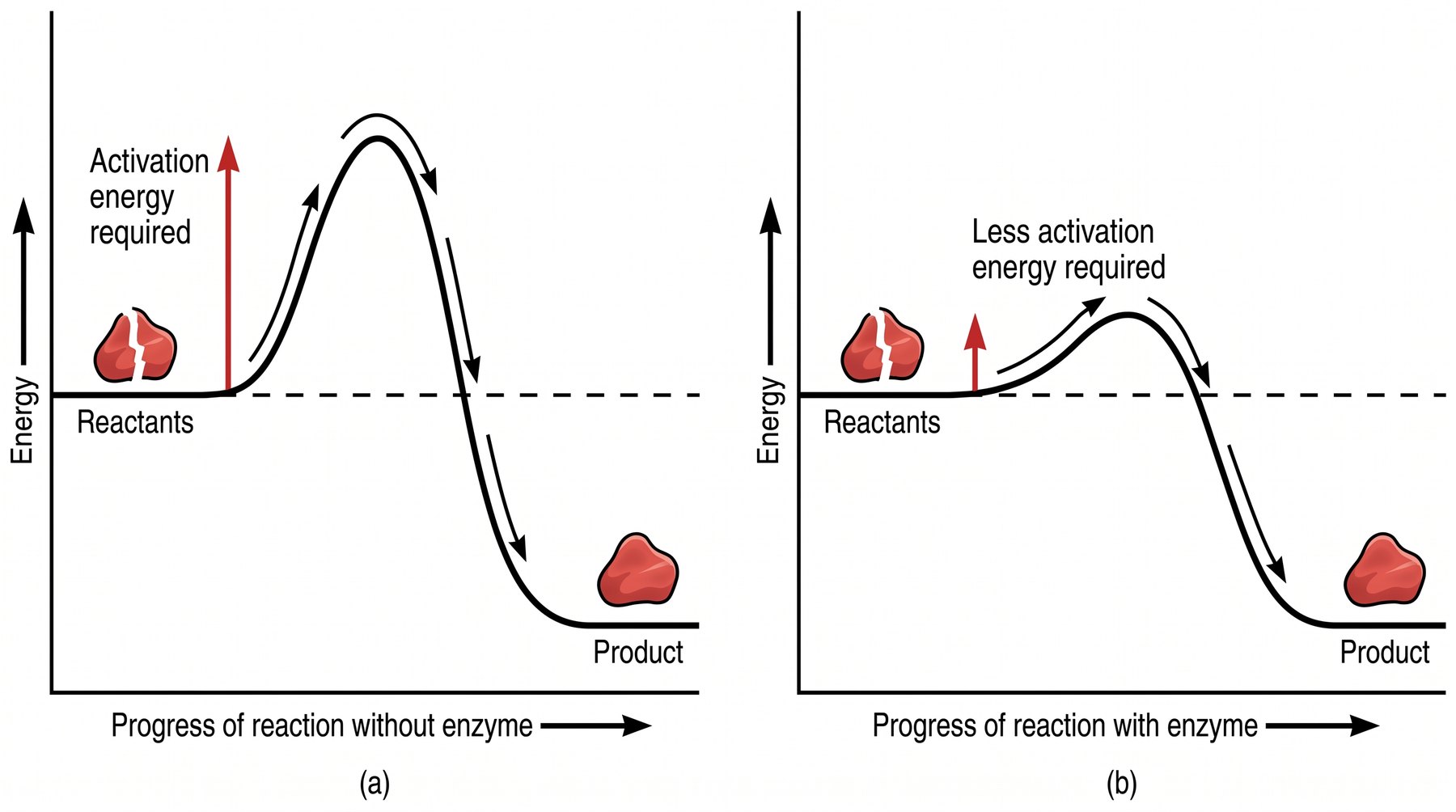
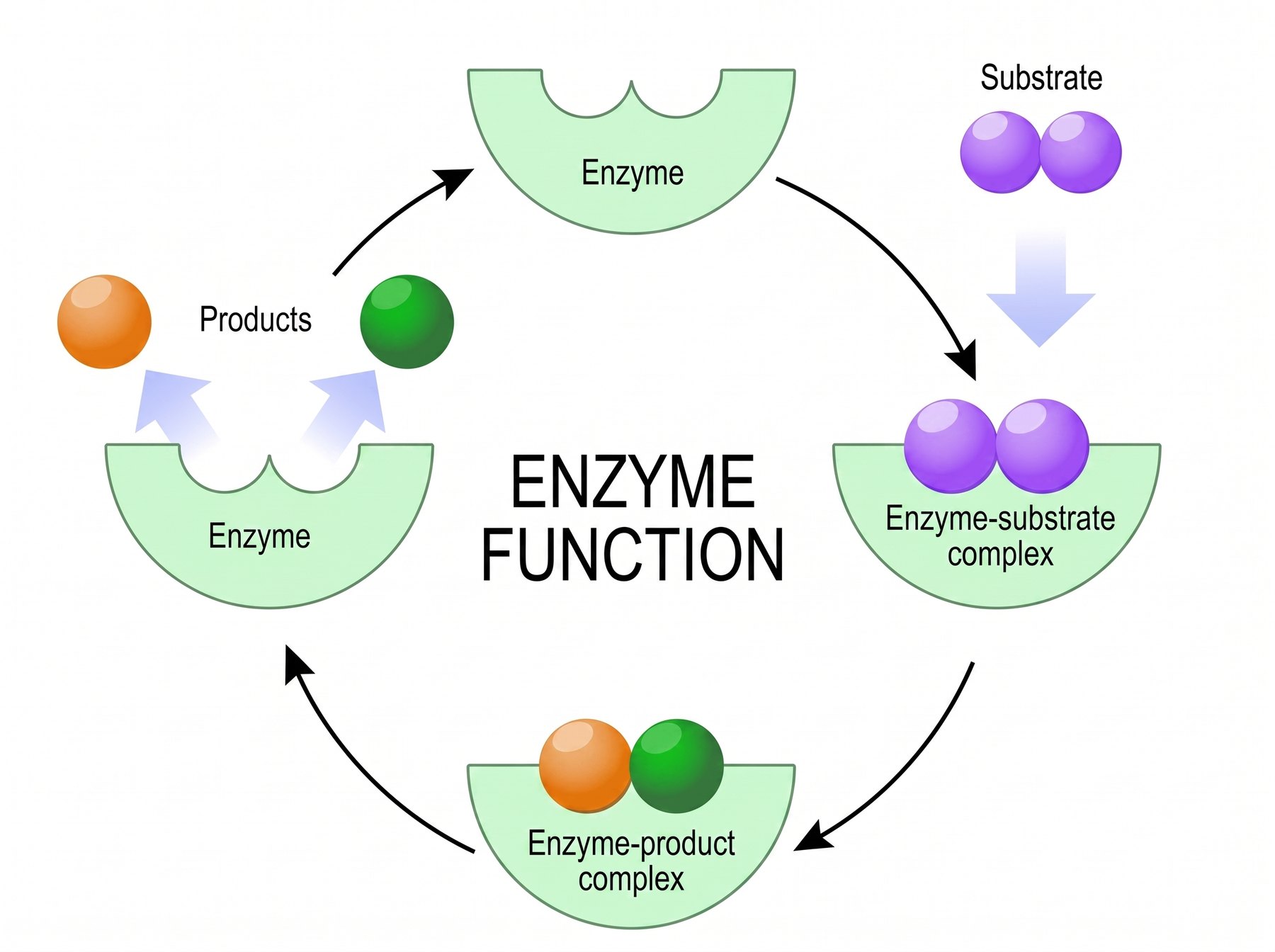
Enzymes are special proteins that speed up reactions by lowering the activation energy — the starting energy a reaction needs. They're catalysts: they aren't used up. Each enzyme has an active site that fits only one substrate, like a lock and key.
This is the part most people find hardest, so take it in two pieces: first what activation energy is, then what enzymes do to it.
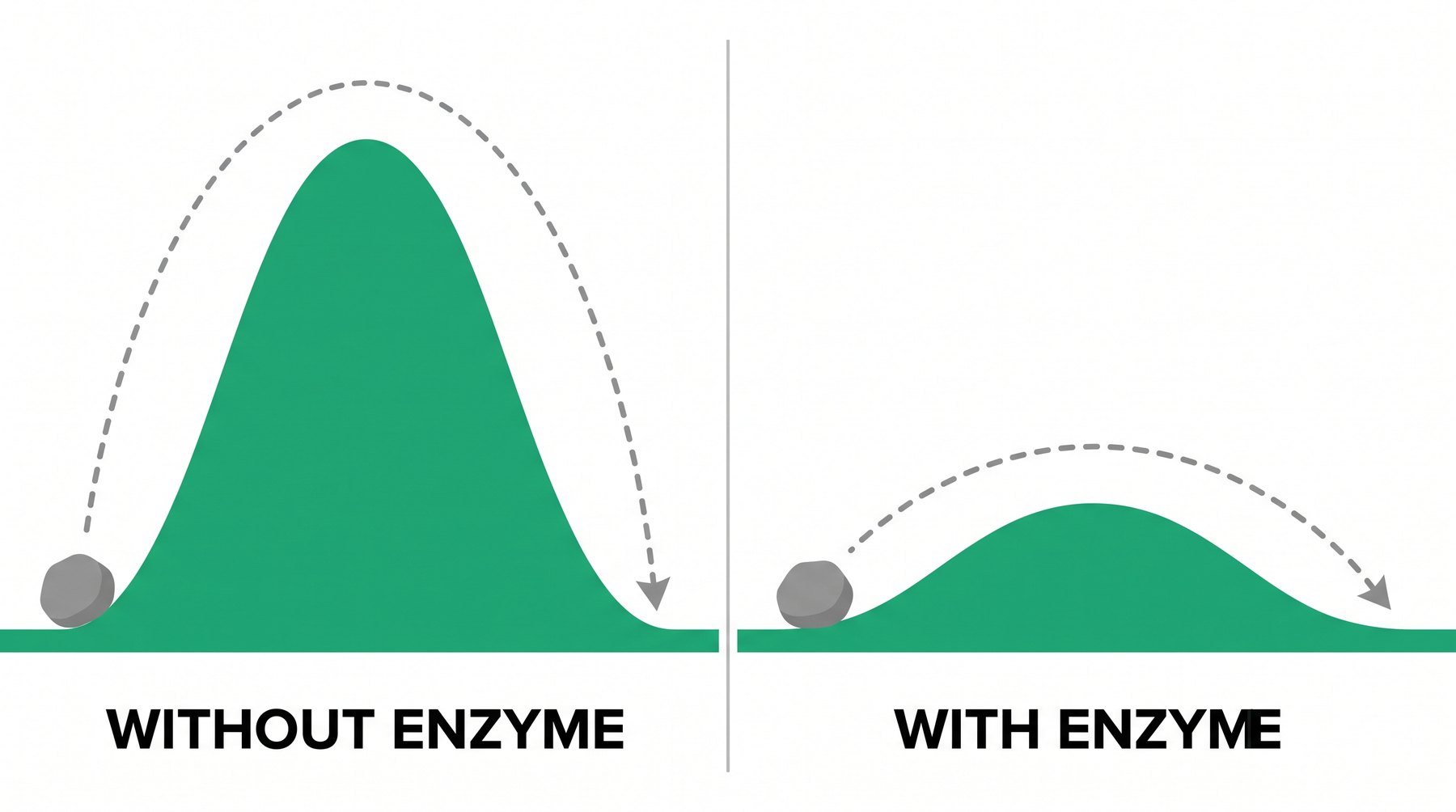
Activation energy = the push to get started
Some reactions need a shove before they'll go. That starting shove is activation energy.
Think of pushing a boulder over a hill. Once it's over the top it rolls down on its own — but you have to get it up there first. The hill is the activation energy.
What an enzyme does
An enzyme makes the hill smaller. Same boulder, same starting point, same finishing point — but a much easier hill, so the reaction happens much faster.
That's why on the graph the enzyme line has a lower peak but the same start and end.
Reading the graph
Two curves, same start and same end, different peak heights. The lower peak is the one with the enzyme. If a question shows this graph, that's what it's asking.
Lock and key
Each enzyme has an active site shaped to fit one specific substrate, like a lock that fits one key. That's why each enzyme only does one job.
Catalysts aren't used up
An enzyme helps the reaction happen and comes out unchanged, ready to do it again. The lock isn't destroyed when the key opens the door.
Watch someone else explain it
Enzymes (Amoeba Sisters) — The clearest explanation of enzymes and active sites. Worth the full watch.
An Enzyme-Substrate Meet Cute (60s) — Silly, short, and the lock-and-key idea sticks afterwards.
Quick check — answer out loud before you peek
On an energy graph with two curves, which one has the enzyme — and how do you know?
The one with the lower peak. Enzymes lower activation energy, so the 'hill' is smaller. Start and end points stay the same.
Got it now? Scroll back up and re-read the section — it should land differently.
Denaturing — the essay answer
Lesson Page 6
Enzymes only work in optimal conditions — for humans, around 37–38 °C. Too hot, or the wrong pH, and the enzyme denatures: its shape changes, so the active site no longer fits its substrate and it stops working. Think of a bent key — it won't turn the lock any more.
This is the 4-point essay, so it's worth more than any single multiple-choice question. It's really one idea explained twice.
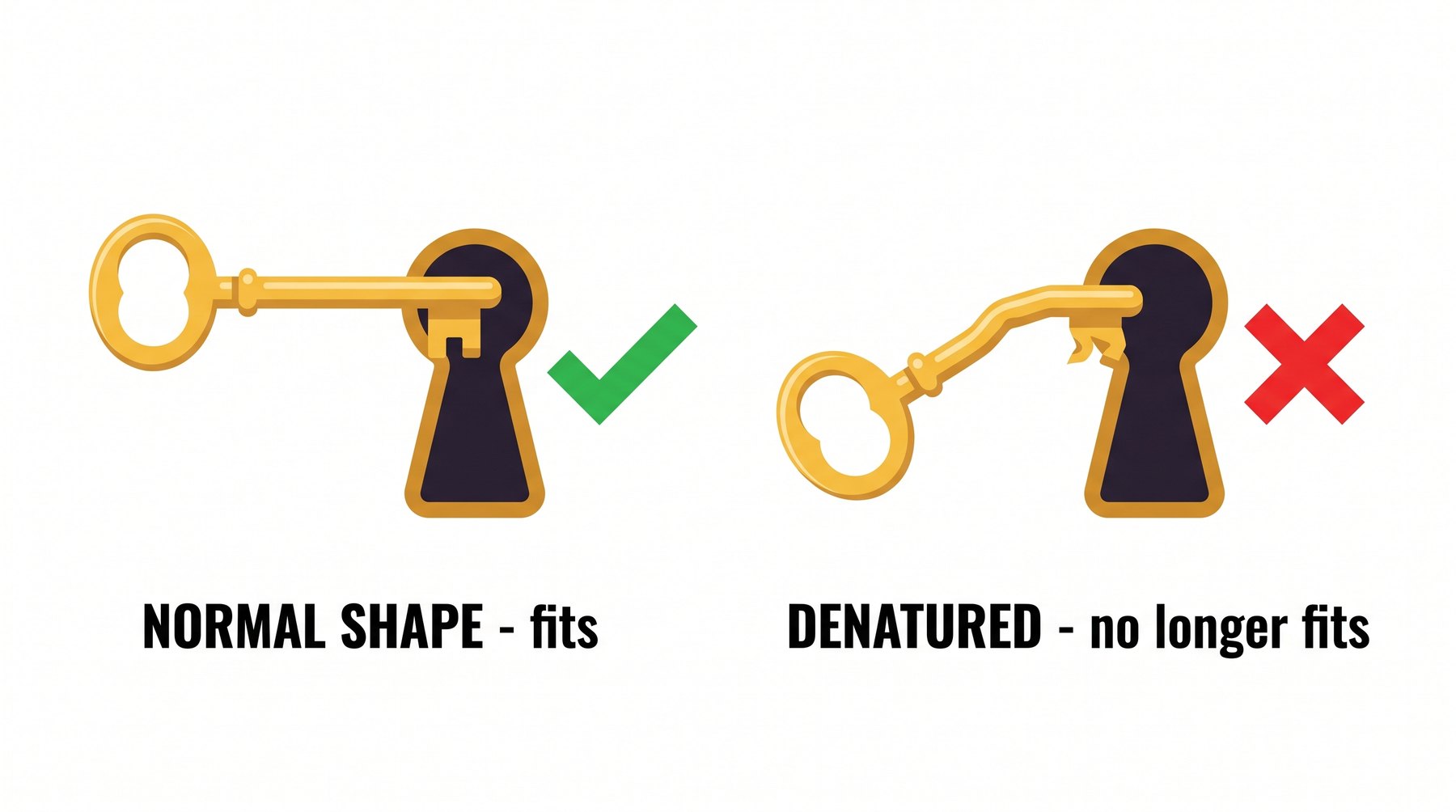
The idea: shape breaks
Enzymes are proteins, and proteins work because of their folded shape. Heat (or the wrong pH) makes that shape unravel. That's denaturing.
Once the shape is wrong, the active site doesn't fit the substrate any more, so the enzyme stops working.
The picture to hold
A bent key. It's still a key, all the metal is still there — but it won't turn the lock. Nothing was destroyed; the shape just changed, and shape was the whole point.
Cooking an egg
Raw egg white is clear and runny. Heat it and it turns white and solid — and it never goes back. That's protein denaturing, and you've watched it happen.
How to write Part 1
Above 50 °C the enzyme denatures — heat changes its shape, so the active site no longer fits its substrate, and the reaction rate drops to zero. Use all three bold words.
How to write Part 2
A fever pushes body temperature above the ~38 °C optimum shown on the graph, so enzymes work more slowly. A high or long fever starts denaturing them, which is why doctors treat 39 °C lasting hours as serious.
Mention the graph. They gave it to you on purpose — name the optimum and describe the sharp drop after it.
Watch someone else explain it
We Don't Talk About Denaturing (60s) — Short and genuinely funny — good for making the word stick.
Quick check — answer out loud before you peek
A friend says 'the fever kills the enzymes'. What's the more precise way to say it?
The heat denatures them — it changes their shape so the active site no longer fits. They aren't killed (they were never alive); they're just the wrong shape now.
Got it now? Scroll back up and re-read the section — it should land differently.
Final checklist
Tick these off before you hit Begin. Saved in this browser.