Ideas this lesson assumes
A lot of schools rush past “organic,” “catalyst,” and prokaryote vs eukaryote. If those are fuzzy, that's about what you were taught, not about you.
You do not need a chemistry degree. You need four words cold.
Inorganic vs organic
Inorganic here means the simple gases and rocks — CO₂, water, nitrogen, not built around carbon chains. Organic means carbon-based (amino acids, sugars, nucleotides).
Catalyst
Something that speeds a reaction without getting used up. In cells, most catalysts are protein enzymes. The plot twist in this lesson: RNA can do that job too.
Prokaryote vs eukaryote
Prokaryote: small, no nucleus (bacteria). Eukaryote: nucleus and extra compartments (plants, animals, fungi, protists). First life was prokaryote.
Hypothesis vs experiment
Oparin and Haldane proposed an idea. Miller and Urey ran a flask. RNA World is a later idea about what the first genetic material was. Don't glue the names onto the wrong claim.
Got it now? Scroll back up and re-read the section — it should land differently.
Match the claim, not just the famous name
Learn these rows cold.
| Idea | What it actually says | Looks like / isn't | How the quiz dressed it |
|---|---|---|---|
| Early atmosphere | Little/no oxygen. Mainly CO₂, water vapor, nitrogen. Hot, volcanoes, no ozone, lots of UV. | Not “lots of oxygen” and not “very cold.” | “Which was likely present over four billion years ago?” → inorganic molecules. |
| Oparin & Haldane | Early conditions let small organic molecules form from inorganic gases (energy from UV/lightning). | They did not run the flask experiment. | Background for Miller-Urey — not the catalyst proof. |
| Miller-Urey | 1953 flask: water, hydrogen, methane, ammonia → amino acids and other small organics. | Did not make living cells. Flask mix was later seen as not exact early Earth. | Shows organic-from-inorganic is possible. Not the RNA-as-catalyst story. |
| Meteorites | Some organics (including amino acids) may have arrived from space. | Not “life rode in on an exploding meteorite.” | “Organic molecules from spontaneous synthesis or from meteorites.” Also: meteorites had inorganic molecules, like early Earth. |
| RNA World | Early self-replicating molecules were RNA; DNA came later. RNA can store code AND catalyze (including making more RNA). | Not the same as “amino acids formed the first life.” | Two costumes: (1) why we share a genetic code; (2) what proved proteins aren’t the only biological catalysts. |
| First cells | Prokaryotes, anaerobic heterotrophs, ≥3.5 billion years ago. Food = organics in the ocean. | Not eukaryotes, not fish. | Cyanobacteria later added oxygen; aerobic life took over. |
If the question is about catalysts / enzymes / “only proteins” → RNA World (Cech: RNA itself catalyzes).
If the question is about a shared genetic code → self-replicating RNA.
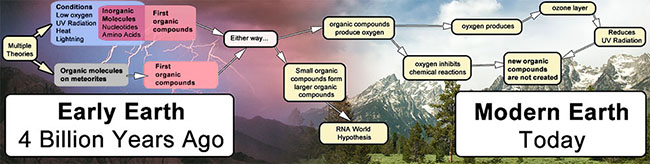
If the question is about what was in the air → little oxygen, inorganic molecules, UV (no ozone).
Lookalike choices recycle: abundance of oxygen · very cold · inorganic molecules · low UV. Pick the one that matches the stem.
What early Earth was actually like
Lesson Page 2
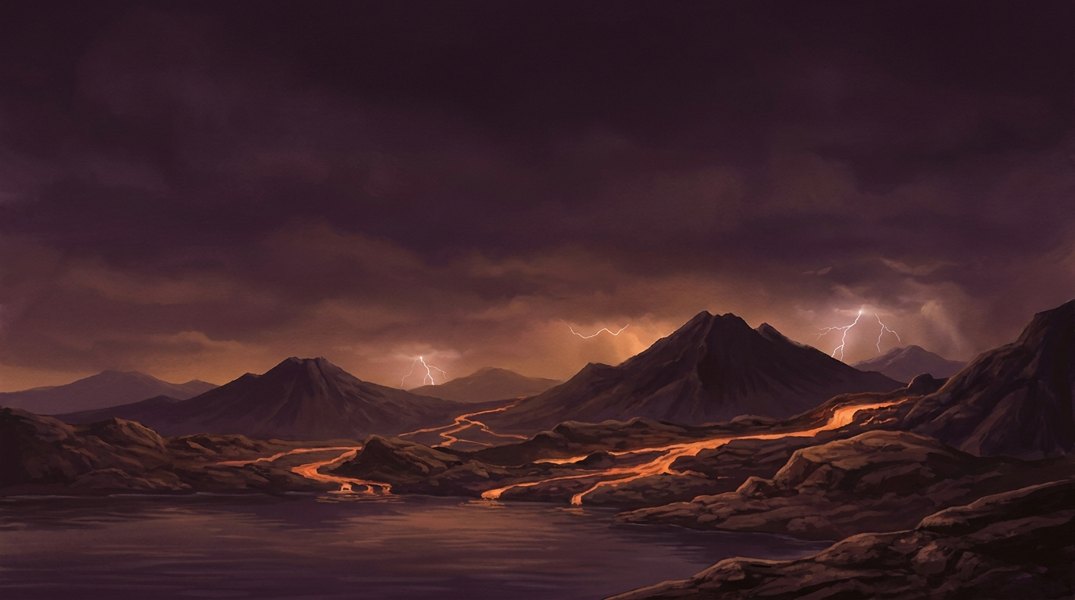
Hot, volcanoes, no protective atmosphere, bombarded by comets and asteroids. Around 4.2 billion years ago it cooled enough for oceans. The air was like volcanic gases: little to no oxygen, mainly carbon dioxide, water vapor and nitrogen. Extra traces: carbon monoxide, hydrogen sulfide, hydrogen cyanide. No ozone layer, so UV got through — that’s energy for chemistry, not a “low UV” world.
Organic molecules — here or from space
Lesson Pages 2–4
Organic = carbon-based. First ones were probably amino acids and nucleotides. Two origin paths: (1) made here from inorganic gases (Oparin/Haldane, then Miller-Urey); (2) arrived on meteorites. Bigger molecules could form when ocean splash evaporated on hot sand, clay or rock — no enzymes needed yet. Today’s oxygen blocks those spontaneous reactions.
RNA World — two different questions, one idea
Lesson Page 4
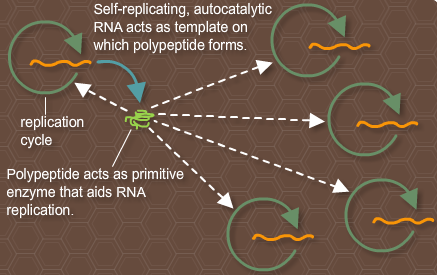
Some of the first large self-copying molecules were RNA; DNA came later. RNA carries code for proteins. Thomas Cech showed RNA is also a catalyst — it speeds reactions, including building new RNA. The old view was “only proteins catalyze.” RNA World is what knocked that down. If RNA can copy itself, that also helps explain why all organisms share a genetic code.
Same chapter, two quiz costumes. That's why this one is easy to miss.
Costume 1 — genetic code
If RNA could copy itself, that information could be passed along. That helps explain why living things share a code.
Costume 2 — catalysts
People thought only protein enzymes sped up biology. Then RNA was shown to catalyze reactions (including making more RNA). That's RNA World knocking down “only proteins.”
Wrong famous names
Miller-Urey = flask amino acids. Oparin/Haldane = “it could happen in that atmosphere.” Endosymbiosis = later, how eukaryotes got mitochondria. None of those are the catalyst proof.
Got it now? Scroll back up and re-read the section — it should land differently.
First cells and oxygen
Lesson Pages 5–6
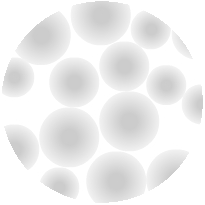
First true cells by ~3.5 billion years: prokaryotes (no nucleus), anaerobic, heterotrophs eating ocean organics. Cyanobacteria later photosynthesized and dumped oxygen. Aerobic autotrophs and heterotrophs took over. Microspheres (tiny organic bubbles) can keep a different inside, store energy, and split — not true cells, but a possible step, especially if RNA is inside.
Final checklist
Tick these off before you hit Begin. Saved in this browser.